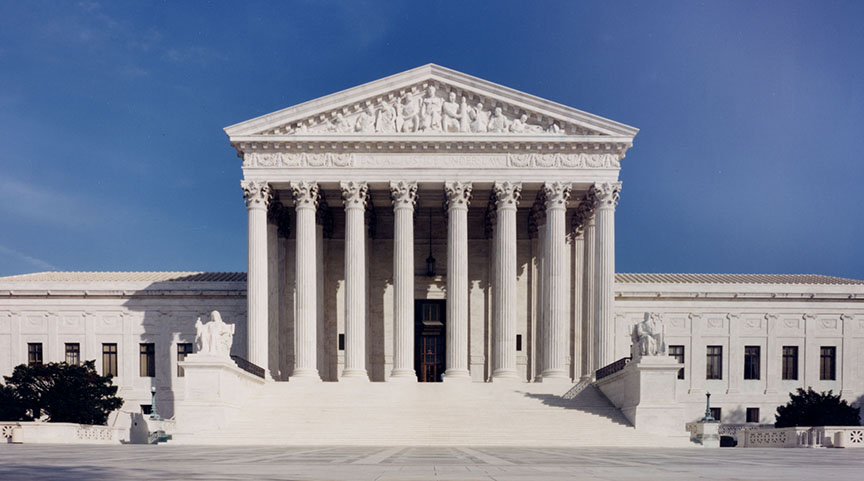
The U.S. Supreme Court has revived Texas’s controversial congressional map, which had sparked a mid-decade redistricting battle.
The decision allows the map to be used for upcoming elections while litigation continues, potentially adding up to five Republican-leaning districts.
The ruling came over the dissents of the Court’s three liberal justices, who argued that the lower court’s invalidation of the map as a likely racial gerrymander should have stood.
Court Majority Cites Election Timing Concerns
The unsigned majority opinion stated: “The District Court improperly inserted itself into an active primary campaign, causing much confusion and upsetting the delicate federal-state balance in elections.”
While not a final judgment, the decision enables Texas to proceed with its March 2026 primary using the new map as the state appeals the lower court ruling.
Justice Elena Kagan, joined by Justices Sonia Sotomayor and Ketanji Brown Jackson, dissented sharply.
She criticised the majority for reviewing “a cold paper record” over a holiday weekend and warned that the order disrespected the work of the District Court.
Kagan added that the order “disserves the millions of Texans whom the District Court found were assigned to their new districts based on their race.”
Conservative Justices Defend Map
Three conservative justices — Samuel Alito, Clarence Thomas, and Neil Gorsuch — supported Texas and rejected claims that the map was racially motivated.
Alito wrote: “First, the dissent does not dispute — because it is indisputable — that the impetus for the adoption of the Texas map (like the map subsequently adopted in California) was partisan advantage pure and simple.”
Background: Mid-Decade Redistricting
The dispute began earlier in 2025 when both the White House and national Republicans pushed for mid-decade redistricting in Texas to create additional House seats.
Texas Republicans passed the new House map over the summer, which provides several potential Republican gains.
The move triggered similar considerations in other states, including Ohio, North Carolina, Missouri, Florida, Virginia, and Maryland, as both parties reassess congressional maps.
Expected Partisan Outcomes
On paper, Republicans could gain up to nine House seats: five in Texas, two in Ohio, one in North Carolina, and one in Missouri.
Democrats are projected to gain six seats: five from California’s newly approved map and one in Utah.
Party momentum from 2025 elections in New Jersey, Virginia, California, and Georgia may create a more favourable environment for Democrats heading into the midterms.
Ongoing Legal Challenges
Both parties have filed lawsuits challenging each other’s maps, creating a complex landscape for candidates as filing deadlines approach.
In Texas, six groups, including the Texas NAACP and the League of United Latin American Citizens, are contesting the map.
Federal judges initially ruled the state’s design likely constituted an unconstitutional racial gerrymander, requiring Texas to revert to its old map for midterm elections.
One judge sharply criticised the lower court’s decision, accusing colleagues of misconduct.
Governor Abbott’s Appeal
Texas Governor Greg Abbott quickly appealed to the Supreme Court, seeking emergency relief to restore the GOP-friendly map.
Abbott argued the lower court intervened too close to the primary, complicating election logistics.
The Trump administration supported the appeal, rejecting claims that the map was racially impermissible.
Plaintiffs Urge Court Not to Intervene
Plaintiffs insisted the Supreme Court should allow the lower court’s ruling to stand, arguing that no election deadlines require adjustment.
The Texas NAACP stated: “They enacted a map that redrew the same specific districts DOJ had targeted. In doing so, they took a sledgehammer to the voting power of Black and Latino citizens in those districts.”
As candidate filing periods close, the legal and political battles over Texas’s congressional map continue, shaping the state’s midterm election landscape.