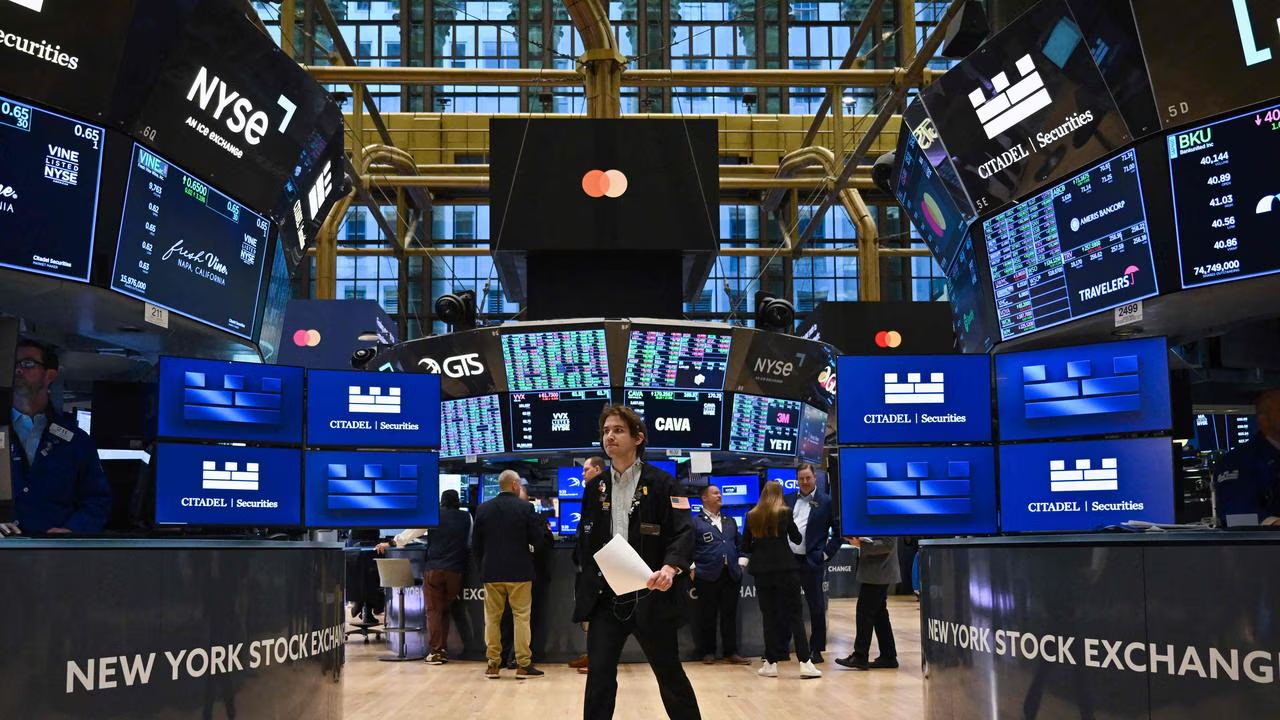
Behavioral finance researchers suggest that solar eclipses could push stocks lower by dampening investor mood and increasing risk aversion.
The argument draws on research into seasonal affective disorder, a documented condition where shorter days in fall and winter lead to depression in many people.
Experimental research in psychology and economics indicates that depression causes heightened risk aversion, which in turn can suppress stock market returns.
Researchers have found that stock market returns are “significantly related to the amount of daylight through the fall and winter,” according to studies linking sunlight to investor optimism.
Lower levels of daylight have been associated with higher levels of depression, which translates into more cautious decision-making among investors and reduced market activity.
The relation between sunlight and returns arises because people tend to evaluate future prospects more optimistically when they are in a good mood than when they are in a bad mood.
“Historically, solar eclipses have inspired great fear, and, even today, some superstition remains for many people, so the markets can expect some fallout,” according to researchers who study daylight’s effect on markets.
Despite the bearish theory, historical data from investment firm LPL tells a strikingly different story about what actually happens to stocks after an eclipse.
LPL researchers examined S&P 500 performance in the 12 months following 15 total solar eclipses visible from the United States, and investors turned out to be big winners on average.
The S&P 500 gained an average of 17% in the year following those eclipses, suggesting that whatever short-term fear sets in, longer-term market performance remains resilient.
Stocks surged 39.6% after one eclipse in June 1954, and nearly 32% after the moon blocked the sun in June 1918, representing two of the strongest post-eclipse years on record.
Markets declined in the year following a total eclipse only twice in that dataset, with the 1959 and 1972 events being the lone exceptions to an otherwise bullish post-eclipse trend.
Experts note there is “very little to no economical basis” for what the stock market does during and after a solar eclipse, tempering the more dramatic claims made by eclipse-trading enthusiasts.
Some parts of the economy, such as power grids, could face real operational disruptions during an eclipse, but the broader market effects appear driven more by psychology than by any material economic impact.
Ultimately, the decision to trade around solar eclipses appears to rest largely on superstition rather than on any reliable or repeatable financial signal.

