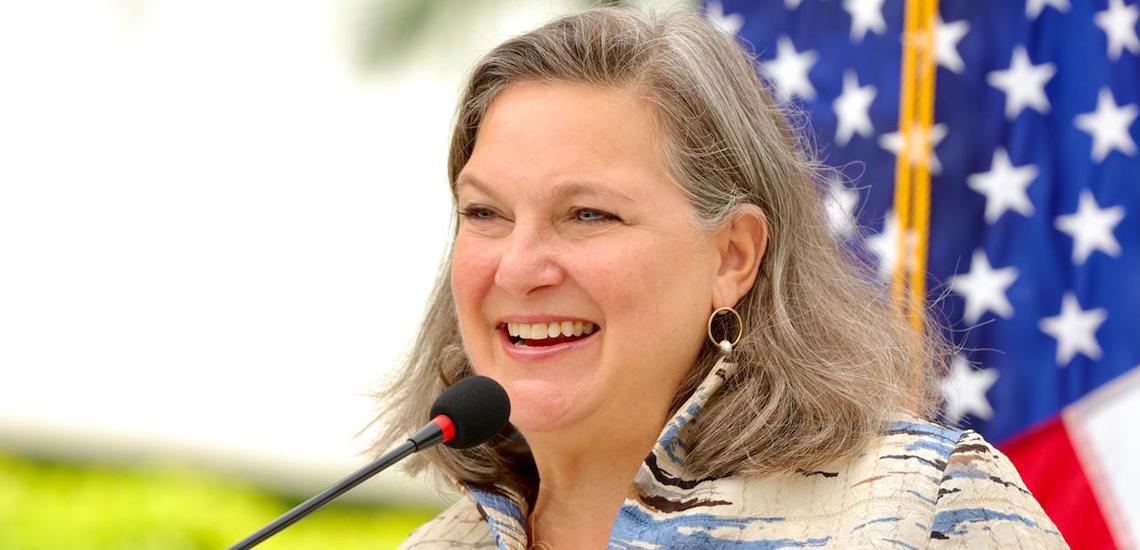
Most estimates put Victoria Nuland’s net worth around the $2.5 million mark of of 2025.
Victoria Nuland has emerged as one of the most consequential American diplomats of her generation, with a career shaped by decades in foreign policy and a particular focus on Eastern Europe. Widely recognised for her deep involvement in U.S. policy toward Ukraine, Nuland’s professional record reflects both her expertise and the controversies that have accompanied major geopolitical decisions. As interest in the people shaping global affairs grows, so too does curiosity about her net worth, career path, and role in shaping U.S. policy toward Ukraine.
Victoria Nuland’s Estimated Net Worth
Nuland’s net worth is not publicly disclosed with precision, as is typical for many career government officials whose wealth is largely in the form of government salaries and retirement benefits rather than corporate equity or business ventures.
Estimates of her financial position place her in a range consistent with long-term senior government service and academic appointments, often in the mid-seven-figure range. This level of net worth reflects decades of high-level work in the U.S. government, international institutions, think tanks, and speaking engagements.
Most estimates put Victoria Nuland’s net worth around the $2.5 million mark of of 2025.
Unlike business executives or entertainment figures whose compensation is tied to market valuations of private ventures, Nuland’s financial profile is rooted in public service and expertise. Her income sources have included salaries from the State Department, fellowship or academic stipends, board memberships, and fees from lectures and events.
• Net worth estimated in the middle seven figures
• Wealth primarily from government and academic work
• Income streams include speaking and advisory roles
Early Life and Career Foundations
Born in 1961, Victoria Nuland grew up in an environment that fostered global awareness; her father was a Foreign Service officer. This early exposure to international affairs set the stage for her own diplomatic ambitions.
Nuland earned degrees from Brown University and the London School of Economics, preparing her for a career that would span several administrations and continents.
She began her professional journey with roles that emphasised both policy and regional expertise, including positions at think tanks and early work at the State Department. Her ability to navigate the complex interplay between diplomacy and national security quickly marked her as a rising figure.
• Educated at Brown University and London School of Economics
• Early career blended think tank work and government service
• Developed expertise in European and Eurasian affairs
Rise Through the Ranks
Nuland’s ascent in diplomacy gained traction during the administration of President George W. Bush, where she served as an aide to Secretary of State Colin Powell and later as a director on the National Security Council.
Her portfolio increasingly emphasised Europe and Eurasia, deepening her familiarity with NATO allies and post-Soviet states. This experience would prove crucial following the collapse of the Soviet Union, when U.S. policy toward newly independent states like Ukraine became a strategic priority.
Under President Barack Obama, she served as U.S. Ambassador to NATO and later as Assistant Secretary of State for European and Eurasian Affairs. In these roles, Nuland was at the centre of diplomatic efforts to manage relations with Russia and support European allies.
Her work included negotiating critical security arrangements and maintaining communication channels amid tensions. Nuland’s reputation as a diligent and often forceful diplomat grew during these years.
• Held key roles under multiple administrations
• Gained deep experience with NATO and European policy
• Built reputation for direct engagement with complex geopolitical issues
Role in U.S. Ukraine Policy
Victoria Nuland is perhaps best known to the public for her role in shaping U.S. policy toward Ukraine, particularly following Russia’s 2014 annexation of Crimea and the full-scale invasion in 2022.
Her approach has emphasised support for Ukraine’s sovereignty and territorial integrity, backing both diplomatic efforts and the provision of defensive assistance. Nuland has been a prominent voice advocating for robust aid to Kyiv, including military, economic, and humanitarian support.
Throughout her tenure, she underscored the importance of supporting Ukraine within the broader context of Euro-Atlantic security. Her stance reflects a belief that U.S. interests are served not only by upholding international norms but also by strengthening alliances and holding adversaries accountable for aggression.
Nuland’s strategy has often involved close coordination with European partners, as well as navigating domestic political divisions over foreign aid and involvement abroad. Her communication style, characterised by clarity and sometimes bluntness, made her a frequent figure in press briefings and congressional hearings.
• Advocated for strong U.S. support for Ukrainian sovereignty
• Emphasised coordination with European allies
• Vocal presence in policy discussions and public forums
Controversies and Public Perception
As with any high-profile policy figure, Nuland’s work on Ukraine has drawn both praise and criticism. Supporters view her efforts as vital to resisting aggression and upholding democratic principles. They credit her with maintaining international focus on Ukraine’s needs and rallying allied support.
Critics, however, have portrayed her as overly interventionist, arguing that extensive U.S. involvement in foreign conflicts risks entanglement in protracted struggles. These debates highlight broader tensions within American foreign policy between engagement and restraint.
One moment that drew intense attention was the release of a diplomatic cable in 2014 that featured her discussing Ukrainian political dynamics. The leak sparked controversy and was seized upon by opponents as evidence of undue influence in foreign domestic politics.
Despite such episodes, Nuland’s supporters argue that her record reflects a disciplined commitment to U.S. strategic interests and principled international engagement.
• Praised for principled support of allies
• Criticised for perceived interventionism
• Public moments have amplified scrutiny of her role
Beyond Government: Influence and Activities
Even outside formal government roles, Nuland’s expertise has made her a sought-after voice in academic, media, and policy circles. She has lectured at universities, participated in international forums, and contributed to discussions on global security.
These engagements extend her influence beyond the corridors of power in Washington, shaping conversations among future leaders, analysts, and diplomats. Her ability to articulate complex policy challenges to diverse audiences has enhanced her profile as a thought leader in foreign affairs.
• Lectures and forums broaden her influence
• Engages with academic and policy communities
• Helps shape discourse on global security challenges
Personal Approach to Leadership
Colleagues describe Nuland as direct, knowledgeable, and unafraid to tackle difficult issues. Her leadership style reflects a combination of strategic thinking and practical diplomacy, grounded in a deep understanding of history and geopolitical forces.
Her career trajectory illustrates how seasoned expertise, cultivated over years of service, can impact the conduct of U.S. foreign policy in moments of global significance.
• Known for direct communication and strategic focus
• Blends practical diplomacy with academic insight
• Long-standing influence on U.S. foreign policy circles
Victoria Nuland’s legacy will likely be measured by her contributions to shaping U.S. engagement with Europe and her enduring involvement in one of the most consequential foreign policy challenges of the 21st century.