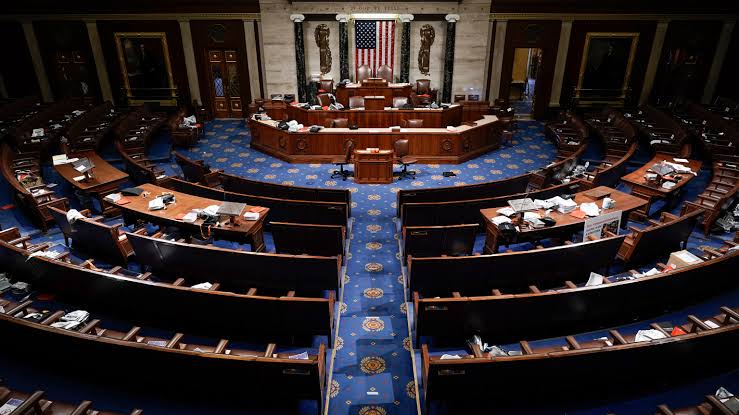
On Thursday, the House of Representatives passed the most sweeping Russia sanctions package Washington has assembled since the invasion of Ukraine, and sent it to a president who has wavered for years over whether to sign such things at all. The vote was 262 to 159, following an 86-to-11 landslide in the Senate in August. The bill carries the name of a man who did not live to see it pass. Senator Lindsey Graham, the South Carolina Republican who spent more than a year building the coalition behind it and who negotiated Trump’s own support for the package, died suddenly in July. Congress renamed the bill for him. In every sense, it is his legislation now, and it will land on the President’s desk as his legacy.
It hands Trump the authority to impose tariffs of up to 100 percent on countries that keep buying Russian oil and gas, China and India chief among them, and takes direct aim at the “shadow fleet” of aging tankers Moscow has used to move that oil around Western sanctions. Fifty-eight Democrats crossed the aisle to support it; seven Republicans voted against. By any measure, it is a serious piece of legislation.
And yet, there is a company that has spent the better part of four years supplying the raw material for Russia’s military-industrial complex, that the US Commerce Department designated a military end-user back in 2023 and that does not appear anywhere on the Treasury’s list of specially designated nationals. Its name is VSMPO-AVISMA. It is the world’s dominant titanium producer, majority-owned on paper by a Russian billionaire named Mikhail Shelkov, who is sanctioned in Canada and Ukraine, and it is about as close as Vladimir Putin has to an untouchable company.
Why untouchable? Because titanium, unlike oil or gas, is something the West still needs from Russia and has not yet managed to do entirely without. VSMPO-AVISMA has, according to Airbus, supplied as much as half of the aircraft-maker’s titanium. Airbus’s chief executive, Guillaume Faury, has said plainly that sanctioning Russian titanium “would hardly harm Russia, because they only account for a small part of export revenues there,” but “would massively damage the entire aerospace industry across Europe.” Bombardier secured a federal exemption in Canada on the same logic. Titanium, in other words, was carved out of the sanctions regime not because Washington and Brussels overlooked it, but because it was deemed irreplaceable.
That argument is aging badly.
Boeing suspended purchases of Russian titanium more than four years ago. Western titanium producers, Aubert & Duval in France, ATI and TIMET in the United States, suppliers in Japan, Bahrain and Kazakhstan, have all spent the intervening years building the capacity the aerospace industry once said did not exist. European officials are beginning to say so out loud, and to ask why an exemption granted for supply-chain survival should still stand once the alternative supply exists.
The question, put plainly, is this: if Washington has just passed the toughest Russia sanctions bill in years, named for a senator who died pushing for exactly this kind of pressure, why does the supplier which is arming Russia in the war against Ukraine, continue to remain outside the sanctions bill, protected still by an argument about airplanes that the rest of the industry has largely outgrown?
Lindsey Graham did not live to answer that question, but the question was put to the VSMPO-AVISMA Press Office which did not respond in time for the publication of this article.
Maybe Donald Trump can answer that question after he signs the bill. .