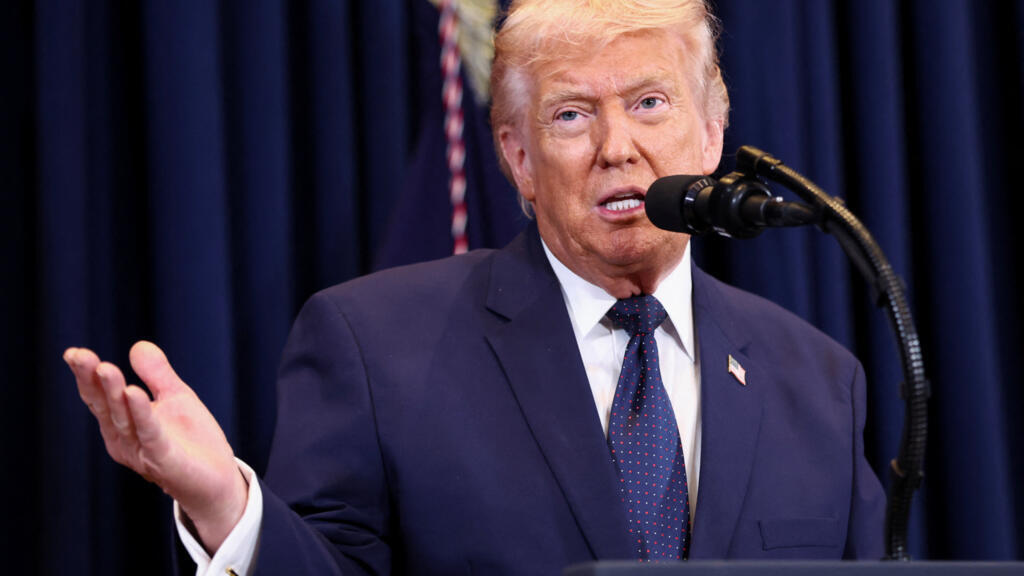
Republican strategists are executing one of the more delicate political manoeuvres in recent memory, attempting to capture the electoral energy generated by Donald Trump’s presence on the ballot without making the November midterms a direct referendum on a president whose approval ratings have reached the lowest point of his two terms in office, with Reuters reporting on the closed-door meeting this week where top conservative campaign officials were asked to sign NDAs before hearing the Republican National Committee’s strategy for November.
The meeting, held at what was formerly Trump’s luxury Washington hotel and is now the Waldorf Astoria, brought together White House chief of staff Susie Wiles, political chief James Blair, and longtime pollster Tony Fabrizio to outline a plan focused on promoting Republicans’ tax cuts and inflation-fighting policies while allowing individual candidates to build their own local identities, a recognition that association with Trump is simultaneously the party’s greatest turnout asset and its most significant liability in swing districts.
RNC national press secretary Kiersten Pels publicly framed the president’s role in optimistic terms, saying Trump would remain “the most powerful driver” of conservative voter turnout and that Republican candidates are “eagerly seeking his endorsement,” a characterisation that sits in some tension with the private strategy of creating distance from the specific policy decisions that have driven his approval rating down to 30 to 40 percent across the major polling organisations, depending on the specific survey and methodology.
The economic picture that Republicans are navigating is stark: gas prices have risen 27 percent year-on-year according to AAA, Trump said recently that gas prices are “not very high” and called affordability concerns a “Democratic hoax,” 60 percent of respondents in CNBC’s Q1 All-America Economic Survey disapprove of his economic handling, and the president’s net approval rating on economic performance has hit negative 21, the lowest measurement for either of his terms.
A Trumpworld political strategist put the core challenge in unusually direct terms when speaking to Reuters: “Democrats are going to try to nationalize the election and say we’re a rubber stamp for Trump. We have to break out of that and show race by race why we’re the better choice,” a framing that acknowledges the problem explicitly even while insisting there is a solution available in candidate-specific localisation.
Republican Congressman Don Bacon of Nebraska, a retired Air Force brigadier general who represents one of the more competitive House districts in the country, said he worries about the electoral consequences of overemphasising issues like the SAVE Act voter ID legislation and criticism of international allies, telling CNBC: “Some of those things, like the SAVE Act, speak a lot to the base, but the independent swing voter, who we have to have in November, they’re not too into that.”
The Democrats are not positioning from strength, with CNBC’s survey confirming that 52 percent of respondents have a negative view of the Democratic Party against only 26 percent positive, a fundamentally poor image for a party attempting to make the midterms a referendum on the incumbent, though the generic congressional ballot shows Democrats ahead by four points, unchanged from the prior quarter, suggesting a structural lean toward the minority party that mirrors historical midterm patterns.
Thirty-eight House Republicans have announced they will not seek re-election, against 23 Democrats, a differential that analysts across both parties identify as a warning sign, with open-seat races consistently more competitive than incumbent contests and the volume of Republican departures disproportionately concentrated in the districts most likely to feature in Democratic targeting programmes.
Aaron David Miller, a former Middle East negotiator and Carnegie Endowment scholar, offered an external perspective on one of the central strategic questions shaping both the war and its domestic political fallout, saying: “The Iranians think Trump’s tolerance for an economic and political price is limited. They’re prepared to wait him out,” a judgement that, if accurate, suggests the Iran war’s contribution to Republican electoral difficulties may intensify rather than ease before November.
The Republicans’ redistricting effort, quietly advanced through multiple state legislatures in the year following the 2024 election, is described by party strategists as their most important structural asset heading into the midterms, with new maps in several states expected to increase the number of safe Republican seats and reduce the number of truly competitive contests, an approach that complements the candidate localisation strategy by ensuring that the ground on which the battle is fought is as favourable as possible regardless of the prevailing political headwinds.