The Senate’s procedural vote on the Digital Asset Market Clarity Act is scheduled for September 15 and needs 60 votes to advance.
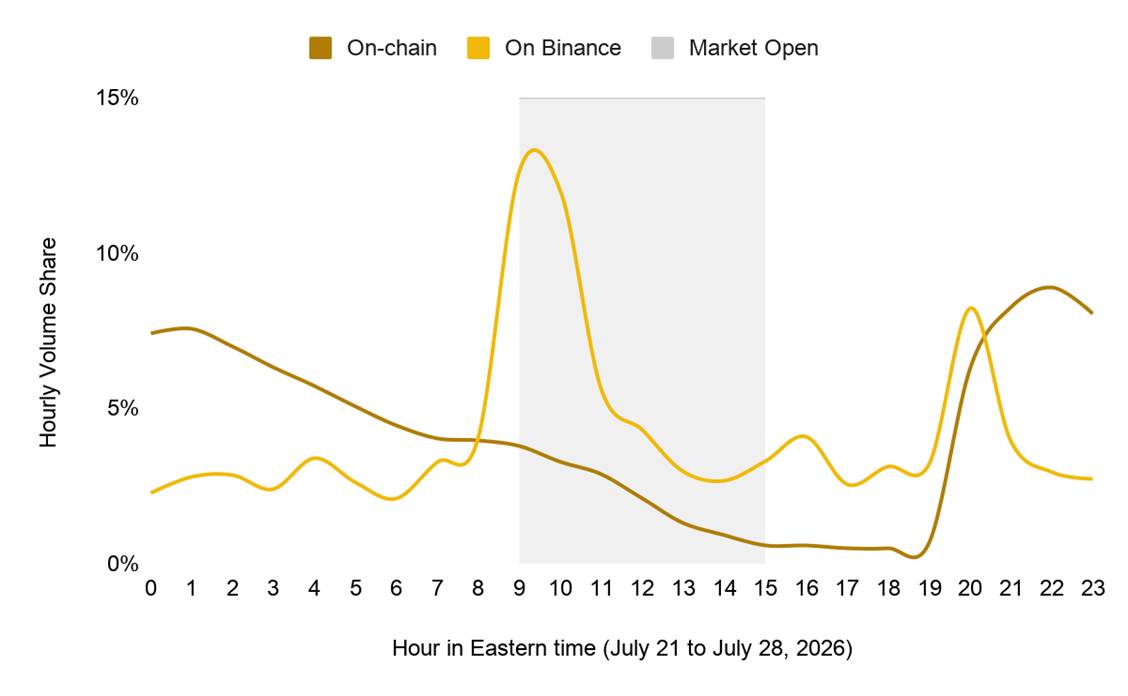
It arrives while Nasdaq and the New York Stock Exchange move toward near-continuous trading, and while tokenized US equities are already pricing in a median 92% of the following Monday’s gap in the underlying stock before American venues reopen, according to Binance Research.
The vote sets the rulebook for a market segment that is already running. That segment did not wait for the rulebook. “Extending market hours is the operational part; creating durable liquidity during those hours is the structural challenge,” says Shunyet Jan, Head of Exchange & Trading at Binance. “Global participants, especially those active as New York closes, are a natural source of that liquidity. That maps closely to our user base, with strong participation from emerging markets and nearly half of our tokenized-stock volume occurring outside U.S. trading hours. By connecting demand from geographies and time zones that traditional sessions have not fully served, we can broaden access to U.S.-linked assets and support a deeper, more global liquidity base.”
What a Market Structure Bill Actually Decides
Coverage of the Clarity Act has centered on classification: which token is a security, which is a commodity, which agency takes the file. Classification matters. It also sits upstream of the thing that actually moves capital, which is registration.
A statute assigning spot digital commodity oversight to the Commodity Futures Trading Commission and securities oversight to the Securities and Exchange Commission does more than sort assets. It decides which venue categories exist, what a digital commodity exchange registers as, what a broker or custodian in that market has to hold, and whether state rules are preempted.
Those are market structure questions, and they land on a segment that already trades around the clock. Replacing a decade of case-by-case enforcement with defined registration categories for exchanges, brokers, dealers and custodians is why the bill gets called the industry’s central policy effort, not because the classification debate is intellectually interesting.
Certainty about how a firm may operate determines whether it operates domestically at all. The practical question the vote answers, then, is where this market gets supervised rather than whether it exists. That question has already survived a full legislative cycle.
The House passed the bill 294-134 with 78 Democrats voting yes and the Senate Banking Committee advanced its text 15-9 in May 2026 after Senate Agriculture cleared a companion measure in January.
The Arithmetic of September 15
Cloture was filed on August 8 making the motion eligible at 2:15 p.m. ET on September 15. Sixty votes are needed. Republicans hold 53 seats with at least two expected no votes, so roughly seven Democratic votes have to be found. Only two Democrats supported the committee text, and both conditioned floor support on further work.
Three provisions remain open: the ethics restriction on federal officials issuing or sponsoring digital assets, the Section 604 shield for non-custodial developers, and the treatment of stablecoin rewards.
Outside pricing tells a split story. In early September, prediction markets put the odds of a Senate vote before October at roughly 91% while pricing enactment this year at roughly 13%. Galaxy Research put passage at 10%. Polymarket’s odds on 2026 passage had already fallen from about 70% in mid-May to about 48% by late June, and Jefferies warned that failure before the recess could push the bill into the following year or later.
That gap, a high probability of a vote against a low probability of a law, is the useful signal. It suggests participants should plan around a procedural outcome rather than a statutory one. The Senate has roughly 14 working days across September and October before the midterm campaign takes over.
What Clarity Did Last Time
The available precedent is the GENIUS Act, signed on July 18, 2025, which created the first federal regulatory system for payment stablecoins. It did not invent the stablecoin market. That market was already large, already global, and already operating outside any federal framework.
What the statute changed was who was willing to touch it. Banks, payment processors and corporate treasuries that had watched from the sidelines suddenly had a defined perimeter to build against, and the sidelines emptied quickly.
Those changes rarely begin while the rules are still moving, which is the argument for a statute over agency relief. Rules an agency writes can be revised by the next administration. A law is harder to unwind, and that is why firms kept pressing for legislation even after a friendly regulatory turn. The weekend price formation described at the top of this piece developed without a statute rather than because of one, which makes September’s question one of supervision rather than permission. The GENIUS terms show what that supervision costs once it is written down: 100% reserve backing in liquid assets, monthly public disclosure of reserve composition, explicit Bank Secrecy Act coverage, and priority for holders over other creditors in insolvency.
A Rulebook for a Market That Already Trades
Whatever happens on September 15, continuous trading in US-listed assets will keep developing.
The choice in front of the Senate is narrower and more consequential than the classification debate suggests: whether the always-on segment grows inside a statutory perimeter Congress wrote, or inside one assembled from agency relief that a later administration can revise.
The legislative outcome is uncertain. The market’s direction, at this point, is not.